When we become compromised beyond repair

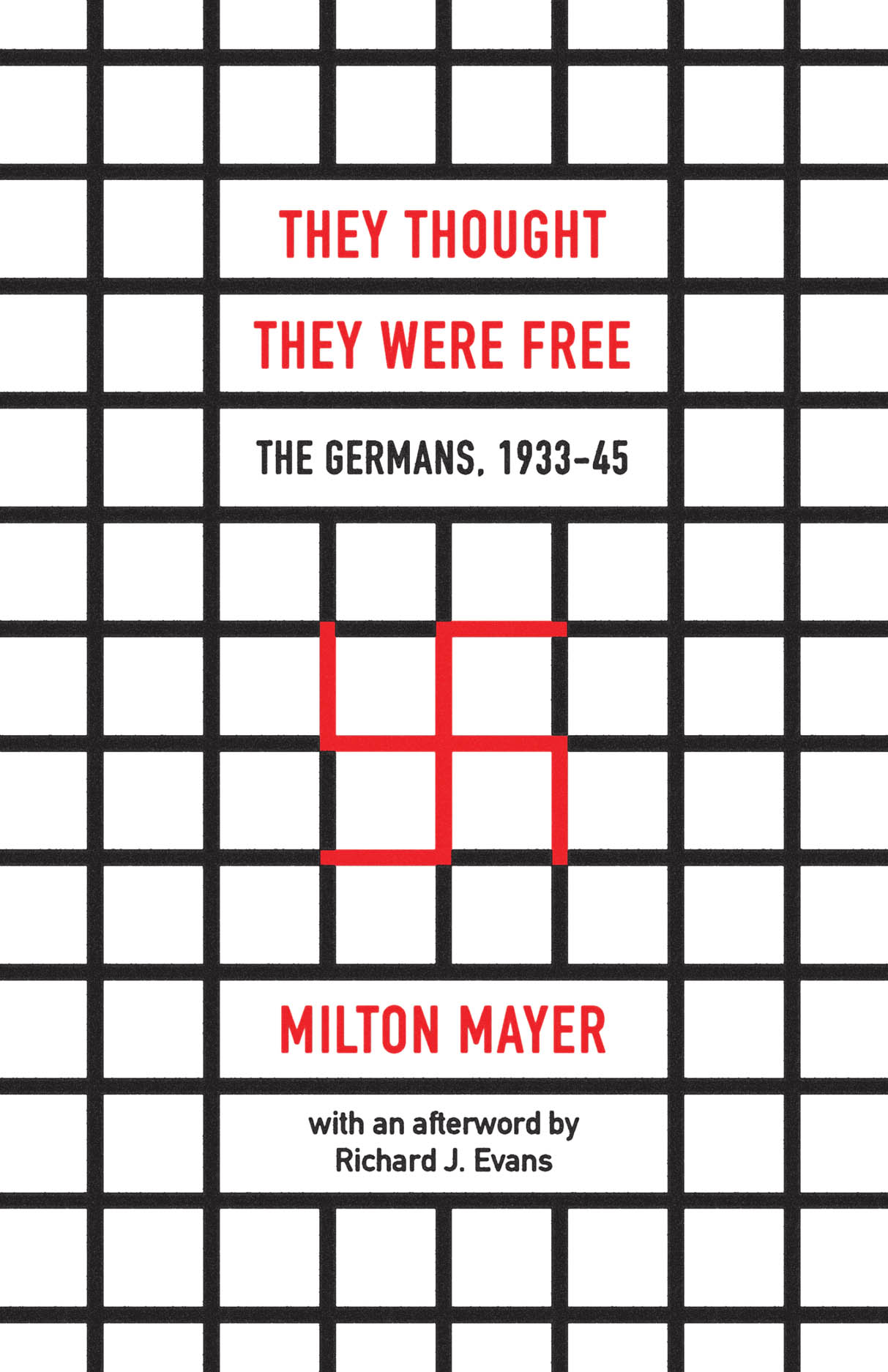
In 1955, University of Chicago Press published Milton Mayer’s They Thought They Were Free: The Germans, 1933-45, a book that captured a series of interviews he did in 1953 with ten men, nine of whom were blue collar workers in what was a mid-sized ruralish city of 20,000 in Germany. The last was a teacher. The book certainly has its flaws, especially with regard to the sample size and the representation—one could argue it was representative of the broad German experience in the way talking to MAGA Republicans in rural diners is representative of American sentiment. That being said, the chapter with the teacher is something I’ve re-read multiple times over the past year.

Journalism is critical, I believe it truly, or I would not still be in a space that frustrates me so. I’m still around because I truly believe in the service of information, storytelling, and record-keeping and I see enough people who care that I am not ready to give up on it. I see incredible work being done by journalists working in awful conditions—those created by factions within the public and those created by their organization’s managers and owners. I see incredible efforts to broaden what news and information is and who gets to participate in creating it. Yet, the field is still dominated by our own institutions that influence and affect everything. I cannot deny how maddening it is to abide the busywork, the manufactured hustle and grind, the performance, and the chase of novelty that so often takes place in this field. So when I think about the busyness that makes it easy to defer to routine in the face of disruption...to cling to deadlines, metrics, and content when staring down the face of truly chaotic, dangerous, and uncertain times I cannot help but think of all that we’re using the busyness to avoid.
"You will understand me when I say that my Middle High German was my life. It was all I cared about. I was a scholar, a specialist. Then, suddenly, I was plunged into all the new activity, as the university was drawn into the new situation; meetings, conferences, interviews, ceremonies, and, above all, papers to be filled out, reports, bibliographies, lists, questionnaires. And on top of that were the demands in the community, the things in which one had to, was ‘expected to’ participate that had not been there or had not been important before. It was all rigmarole, of course, but it consumed all one’s energies, coming on top of the work one really wanted to do. You can see how easy it was, then, not to think about fundamental things. One had no time."
"Those," I said, "are the words of my friend the baker. ‘One had no time to think. There was so much going on.’"
"Your friend the baker was right," said my colleague. "The dictatorship, and the whole process of its coming into being, was above all diverting. It provided an excuse not to think for people who did not want to think anyway. I do not speak of your ‘little men,’ your baker and so on; I speak of my colleagues and myself, learned men, mind you. Most of us did not want to think about fundamental things and never had. There was no need to. Nazism gave us some dreadful, fundamental things to think about—we were decent people—and kept us so busy with continuous changes and ‘crises’ and so fascinated, yes, fascinated, by the machinations of the ‘national enemies,’ without and within, that we had no time to think about these dreadful things that were growing, little by little, all around us. Unconsciously, I suppose, we were grateful. Who wants to think?
The other day on Threads, Emily (@emiliminality) posted a significant reminder about journalism, quoted in part: “in journalism, you’re trained not to say “murder” until a court has decided it. you say “allegedly.” you say “authorities report.” not because the harm didn’t happen, but because institutions control when language becomes “official.”...then in international law, i learned the same move on a global scale. mass killing can be happening. forced displacement can be happening. ethnic cleansing can be happening. but lawyers will say: it doesn’t meet the legal definition of genocide yet....it teaches us to treat violence like a compliance issue instead of a moral emergency, and to turn suffering into a technical debate. to replace urgency with procedure. to wait until responsibility can be minimized before telling the truth out loud....precision matters. accuracy matters. but when technical language becomes a shield against action, it stops being neutral.”
The whole series of posts is worth your time. In journalism, one can be saved from the responsibility and weight of naming things because the default of the practice is to wait until an official source does so. In 2018, hundreds of newspapers coordinated the publishing of editorials defending the importance of a free press and objecting to Donald Trump’s attacks on the media. We don’t wait for officials elsewhere to confirm our own endangerment before acting because we know best what is dangerous to us. We do not extend that same authority to others about their own condition. If we cannot extend others the agency we have granted ourselves, the right to name and respond to the risks to ourselves, how could they trust us to report on theirs? If we reserve the weight and impact of our collective power for self-preservation, why would they believe that we are necessary for theirs?
"To live in this process is absolutely not to be able to notice it—please try to believe me—unless one has a much greater degree of political awareness, acuity, than most of us had ever had occasion to develop. Each step was so small, so inconsequential, so well explained or, on occasion, ‘regretted,’ that, unless one were detached from the whole process from the beginning, unless one understood what the whole thing was in principle, what all these ‘little measures’ that no ‘patriotic German’ could resent must some day lead to, one no more saw it developing from day to day than a farmer in his field sees the corn growing. One day it is over his head.
"How is this to be avoided, among ordinary men, even highly educated ordinary men? Frankly, I do not know. I do not see, even now. Many, many times since it all happened I have pondered that pair of great maxims, Principiis obsta and Finem respice—‘Resist the beginnings’ and ‘Consider the end.’ But one must foresee the end in order to resist, or even see, the beginnings. One must foresee the end clearly and certainly and how is this to be done, by ordinary men or even by extraordinary men? Things might have. And everyone counts on that might.
Technicalities are everywhere. In each headline and post softening what is actually happening underneath the official labels and technical terms. In each decision about what stories are being pushed out on social media or elevated to the top of homepages. Worse maybe than technicalities is the concept of newsworthiness. What makes something newsworthy in the midst of concurrent crises that we’re not even procedurally allowed to call crises because official sources have not deemed them so?
"You see," my colleague went on, "one doesn’t see exactly where or how to move. Believe me, this is true. Each act, each occasion, is worse than the last, but only a little worse. You wait for the next and the next. You wait for one great shocking occasion, thinking that others, when such a shock comes, will join with you in resisting somehow. You don’t want to act, or even talk, alone; you don’t want to ‘go out of your way to make trouble.’ Why not?—Well, you are not in the habit of doing it. And it is not just fear, fear of standing alone, that restrains you; it is also genuine uncertainty.
"Uncertainty is a very important factor, and, instead of decreasing as time goes on, it grows. Outside, in the streets, in the general community, ‘everyone’ is happy. One hears no protest, and certainly sees none. You know, in France or Italy there would be slogans against the government painted on walls and fences; in Germany, outside the great cities, perhaps, there is not even this. In the university community, in your own community, you speak privately to your colleagues, some of whom certainly feel as you do; but what do they say? They say, ‘It’s not so bad’ or ‘You’re seeing things’ or ‘You’re an alarmist.’
"And you are an alarmist. You are saying that this must lead to this, and you can’t prove it. These are the beginnings, yes; but how do you know for sure when you don’t know the end, and how do you know, or even surmise, the end? On the one hand, your enemies, the law, the regime, the Party, intimidate you. On the other, your colleagues pooh-pooh you as pessimistic or even neurotic. You are left with your close friends, who are, naturally, people who have always thought as you have.
Journalists are so attuned to speaking to positions of official power and authority that when the times demand speaking with smaller powers—the community organizers, the new rising political candidates, the mutual aid workers, the activists, the volunteers, the random people who show up for their neighborhood—that suddenly you see posts in journalism social spaces asking for how to find sources or looking for connections. We don’t struggle with the idea and labor of connecting with power because it’s viewed as critical to doing the job. Talking to everyone else though, has often been viewed as pro forma to represent other sides from the official line. What could happen if we stopped forcing people outside of power into only the roles of witness or newsworthy?
"But your friends are fewer now. Some have drifted off somewhere or submerged themselves in their work. You no longer see as many as you did at meetings or gatherings. Informal groups become smaller; attendance drops off in little organizations, and the organizations themselves wither. Now, in small gatherings of your oldest friends, you feel that you are talking to yourselves, that you are isolated from the reality of things. This weakens your confidence still further and serves as a further deterrent to—to what? It is clearer all the time that, if you are going to do anything, you must make an occasion to do it, and then you are obviously a troublemaker. So you wait, and you wait.
"But the one great shocking occasion, when tens or hundreds or thousands will join with you, never comes. That’s the difficulty. If the last and worst act of the whole regime had come immediately after the first and smallest, thousands, yes, millions would have been sufficiently shocked—if, let us say, the gassing of the Jews in ’43 had come immediately after the ‘German Firm’ stickers on the windows of non-Jewish shops in ’33. But of course this isn’t the way it happens. In between come all the hundreds of little steps, some of them imperceptible, each of them preparing you not to be shocked by the next. Step C is not so much worse than Step B, and, if you did not make a stand at Step B, why should you at Step C? And so on to Step D.
Years ago at a Newsgeist, I was in a small conference room with people who wanted to talk about journalism and harm, reparation, and amends. I posed a question to the group during the discussion. I don’t recall my exact wording but the gist was “how many of you would advise your friends, family, or loved ones to not speak to a reporter who shows up at their door if you were caught up in a significant, newsworthy event?” Multiple people raised their hands in that small room. Would you find it interesting also, to know that in two studies decades apart, the majority of doctors surveyed said they do not want the same aggressive life-saving measures applied to them that they often perform on their own patients?
We do to and for others what we would not choose for ourselves. What we are doing by habit, by routine, by procedure, by tradition, is not working and for all our talk of change, we are still repeating so many old patterns.
As a field of practice, so much of journalism has shifted from the critical preventative healthcare model of information service to emergency room operations with theaters of onlookers discussing the patient, their ailment, and the procedure to heal them as if it were all sport, as if it were an academic exercise and not a breathing body—filled with pain but also potential—laying on a table hoping to be saved. Triage is overwhelmed and the toll is rising.
"And one day, too late, your principles, if you were ever sensible of them, all rush in upon you. The burden of self-deception has grown too heavy, and some minor incident, in my case my little boy, hardly more than a baby, saying ‘Jewish swine,’ collapses it all at once, and you see that everything, everything, has changed and changed completely under your nose. The world you live in—your nation, your people—is not the world you were born in at all. The forms are all there, all untouched, all reassuring, the houses, the shops, the jobs, the mealtimes, the visits, the concerts, the cinema, the holidays. But the spirit, which you never noticed because you made the lifelong mistake of identifying it with the forms, is changed. Now you live in a world of hate and fear, and the people who hate and fear do not even know it themselves; when everyone is transformed, no one is transformed. Now you live in a system which rules without responsibility even to God. The system itself could not have intended this in the beginning, but in order to sustain itself it was compelled to go all the way.
"You have gone almost all the way yourself. Life is a continuing process, a flow, not a succession of acts and events at all. It has flowed to a new level, carrying you with it, without any effort on your part. On this new level you live, you have been living more comfortably every day, with new morals, new principles. You have accepted things you would not have accepted five years ago, a year ago, things that your father, even in Germany, could not have imagined.
"Suddenly it all comes down, all at once. You see what you are, what you have done, or, more accurately, what you haven’t done (for that was all that was required of most of us: that we do nothing). You remember those early meetings of your department in the university when, if one had stood, others would have stood, perhaps, but no one stood. A small matter, a matter of hiring this man or that, and you hired this one rather than that. You remember everything now, and your heart breaks. Too late. You are compromised beyond repair.